Step 1: Shut Down the System and Stop the Source
- Set the thermostat to OFF. Do not leave it on FAN, which keeps the coil cold and producing condensate.
- Flip the dedicated 240V breaker for the air handler and the condenser at your main panel.
- If water is dripping from a ceiling, kill the breaker for that room's lighting circuit before touching anything wet.
- Place a 5-gallon bucket under the active drip and lay towels in a 3-foot radius.
- Photograph the drip location, pan condition, and any stained surfaces before you touch anything. Innisbrooke Water Restoration adjusters request these timestamped images on 90 percent of Innisbrooke claims.
Step 2: Locate the Condensate Path
- Identify the air handler. In Innisbrooke homes, it sits in the attic, a utility closet, the basement, or a garage mechanical room.
- Find the primary drain line: a 3/4-inch white PVC pipe exiting the secondary drain pan or the side of the evaporator coil cabinet.
- Find the secondary (emergency) drain line: usually terminates over a window, soffit, or exterior wall. Active dripping from this line means the primary is blocked.
- Locate the condensate trap, a U-shaped or P-trap fitting within 12 inches of the air handler.
- Trace the full run from coil to termination. Note any sections with less than 1/8-inch per foot of slope, since flat or back-pitched runs hold sludge and fail first.
Step 6: Assess Hidden Water Damage
This is where homeowners underestimate the job. A leak that ran for even 6 hours into drywall, insulation, or subfloor needs measurement, not guesswork. Use the following thresholds, which align with the same IICRC moisture targets we hit on every Innisbrooke job. For deeper context on concealed moisture, see our guide on water damage behind walls and hidden leak detection.
- Drywall moisture content above 1.0 on a non-invasive meter requires drying intervention.
- Wood framing above 16 percent moisture content requires dehumidification.
- Insulation that is visibly wet must be removed. Wet fiberglass loses 40 percent of R-value and grows mold within 72 hours.
- Subfloor readings above 18 percent require targeted airflow and possible removal of finished flooring.
- Thermal imaging across the affected ceiling reveals the full wet footprint, which is typically 2 to 3 times larger than the visible stain.
- Check adjacent wall cavities by drilling a 1/4-inch pilot hole at the base plate and inserting a pin meter. Water travels laterally along top plates before it shows on the surface.
Step 7: Dry the Affected Area to Standard
- Extract any standing water with a wet vacuum before deploying air movers.
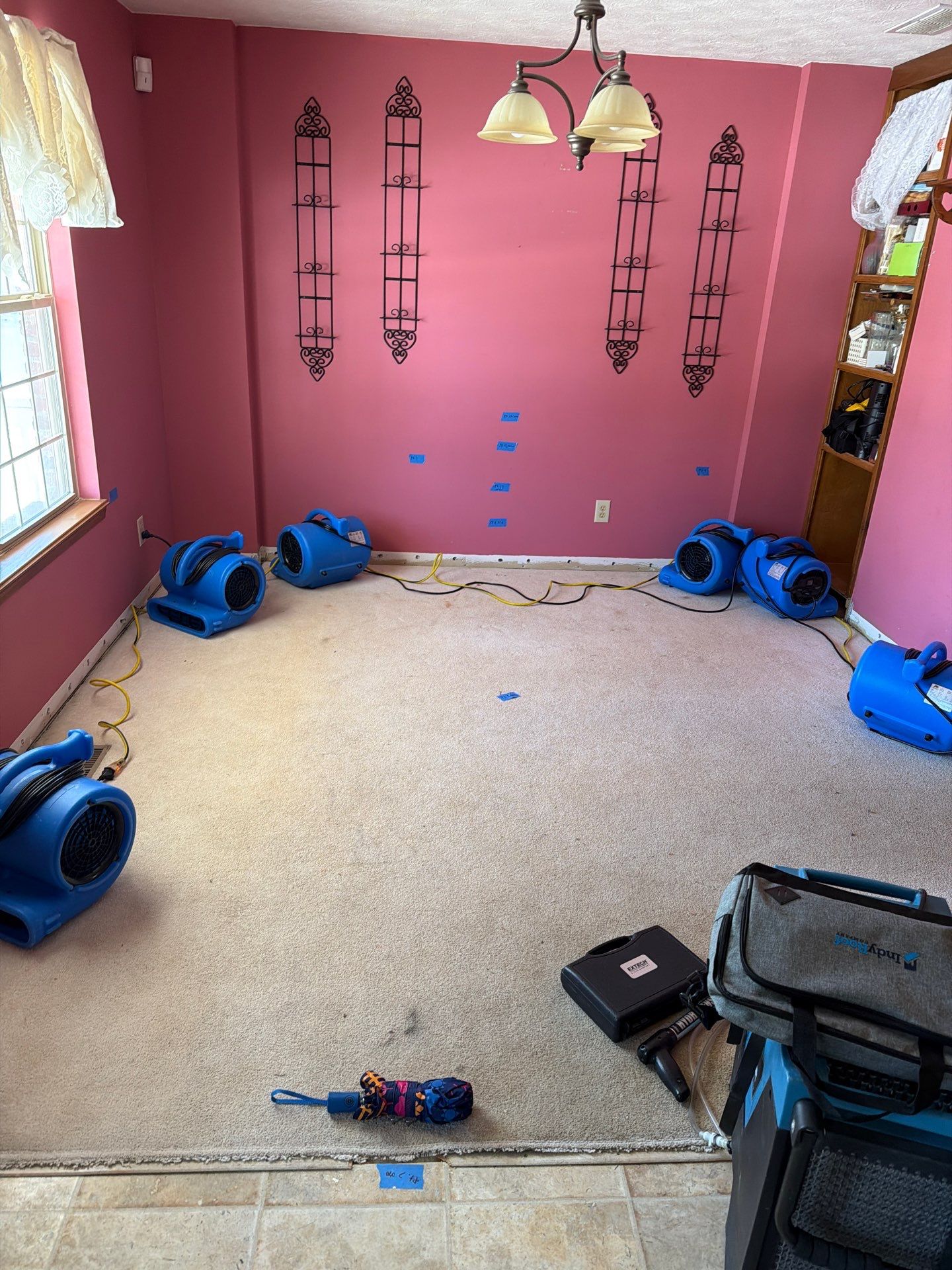
- Place 1 air mover per 10 to 16 linear feet of wet wall, angled at 15 to 45 degrees.
- Add 1 commercial-grade LGR dehumidifier per 500 to 1,000 square feet of affected area.
- Target indoor relative humidity below 50 percent within 24 hours and below 40 percent by day 3.
- Document daily moisture readings. Insurance carriers in Innisbrooke require this log for claim approval.
- Plan on 3 to 5 days of active drying for a typical ceiling cavity leak.
- Remove a 12-inch flood cut of saturated drywall if readings do not drop 4 percent within the first 48 hours of drying.
Step 4: Clear the Condensate Line
- Locate the cleanout tee, a capped vertical PVC fitting above the trap.
- Unscrew the cap. Pour 1 cup of distilled white vinegar into the line. Wait 30 minutes.
- At the exterior termination, attach a wet/dry vacuum to the drain outlet using a rubber coupling. Run for 2 to 3 minutes on high suction.
- You should pull out algae, rust, and a dark slurry. Repeat until the vacuum runs clear.
- Flush 1 gallon of warm water through the cleanout to confirm flow.
- Pour an additional 1/4 cup of vinegar every 90 days during cooling season to prevent regrowth.
- Avoid bleach in copper or galvanized secondary pans. Bleach accelerates corrosion and voids most pan warranties.
Step 5: Repair Cracked or Disconnected Fittings
- Cut out the damaged section using a PVC ratchet cutter, leaving 2 inches of clean pipe on each side.
- Dry-fit a replacement coupling, elbow, or tee. Use Schedule 40 PVC rated for condensate service.
- Apply purple primer, then PVC cement, and seat the fitting with a quarter turn within 20 seconds.
- Allow 2 hours of cure time before restoring power and testing.
- Reinstall the trap with the correct depth: minimum 2-inch water seal for negative-pressure air handlers.
- Add a clear inline cleanout adapter at the new joint. This $8 fitting lets you visually confirm flow during seasonal maintenance.
Step 9: Prevent the Next Failure
- Schedule a coil cleaning and drain flush every 12 months, ideally in early spring before the Innisbrooke cooling load peaks.
- Install a wet-switch float on the secondary pan if your unit lacks one. Innisbrooke Water Restoration technicians wire these in 20 minutes for under $75.
- Replace foam insulation on the suction line every 5 to 7 years. UV exposure and attic heat degrade the closed-cell barrier.
- Keep a 1-gallon jug of distilled vinegar near the air handler so quarterly maintenance is a 2-minute task.
- Log every service date on a label affixed to the air handler cabinet. This record cuts diagnostic time on future calls in half.
Step 8: Decide Repair vs. Restoration
If the leak ran under 4 hours and stayed inside the secondary pan, a vinegar flush and a $30 in fittings usually resolves it. If you see brown ceiling stains, swollen baseboards, or musty odor within 48 hours, you are in restoration territory. Costs in Innisbrooke typically run $1,200 to $4,500 for ceiling and insulation work, and $3,500 to $9,000 if subflooring or hardwood is involved. Review our full water damage restoration cost breakdown before you call your adjuster. Most homeowners' policies cover sudden AC leaks under Coverage A, but not gradual damage, so timing your claim within 14 days matters. For severe cases involving multiple floors, our water damage restoration team handles documentation, drying, and reconstruction under one project number.
Step 3: Diagnose the Failure Point
- Inspect the drain pan under the coil for standing water deeper than 1/4 inch. Standing water indicates downstream blockage.
- Check the secondary pan beneath attic units. Rust, biofilm, or a tripped float switch confirms primary line failure.
- Run a finger along the PVC fittings. Loose joints, missing primer, or hairline cracks at elbows cause 30 to 40 percent of leaks we see in Innisbrooke.
- If the pan is dry but the ceiling below is wet, suspect a refrigerant line condensation issue at the suction line insulation.
- Test the float switch by lifting the float manually. The blower should not start when the thermostat calls for cooling. A non-responsive switch is a $15 replacement that prevents the next overflow.
- Inspect the trap for a dry seal. Negative-pressure handlers can suck air through a shallow trap, pulling water out of the loop and creating an indoor humidity spike.